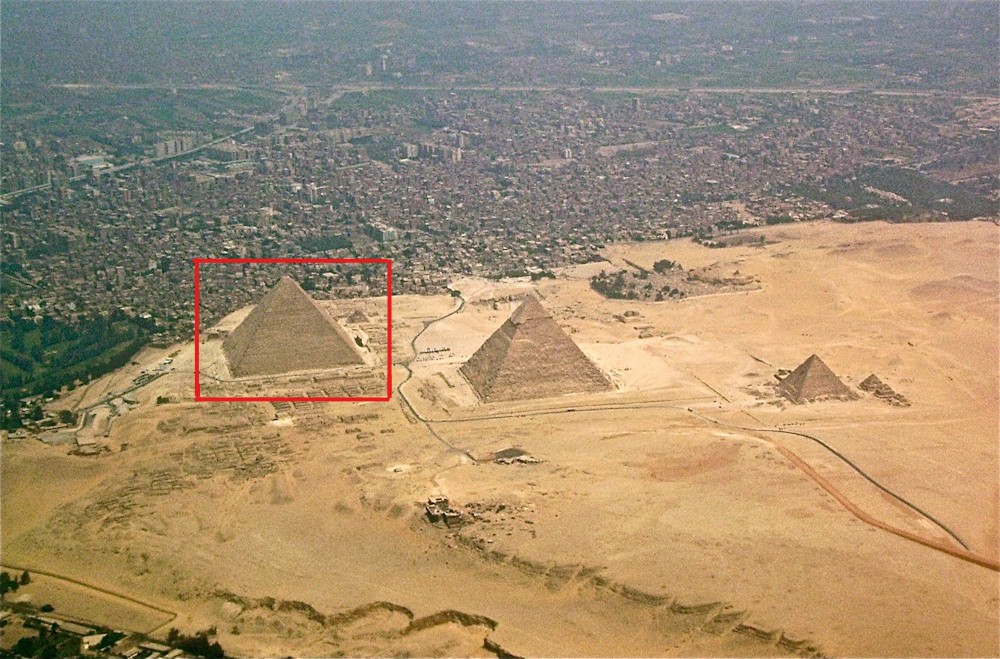
The Giza Plateau in Egypt remains a truly fascinating site, as is evident from the large number of people who, over the years, have been visiting it, thinking about it, and researching it. On this limestone plateau stand three main pyramids in a row (from North to South): the Great Pyramid, the Khafre pyramid, and the Menkaure pyramid, the latter significantly smaller than the other two. Some of the structures on the plateau date back to the distant past and show megalithic features, while others date from Dynastic Egypt (3100 BC to 332 BC). It is important to keep in mind that this architecture comprises several time periods in history, each of which brought recycling and rebuilding with it. Therefore you cannot look at the plateau as a whole and draw conclusions from that. I will therefore just pick the Great Pyramid out of it, because it is the most intriguing, and it looks relatively untouched over the millennia (at least on the inside) mainly due to its massive stone construction material. Also keep in mind that what we see of the structure now is the stripped-down version; you only see the stone casings, not what they originally contained. Thinking out loud about all of that is the fun part here. Thereby we will follow the Serbian-American engineer Nikola Tesla in his innovative ideas about creating his World Wireless System.
Architecture and building materials
The core bulk masonry of the Great Pyramid consists of local yellowish coarse-grained Mokattam limestone, mined on the site. These blocks are generally less precise than the outer stones, with gaps often filled with a gypsum-based mortar.
The outer casing of the Great Pyramid consists of tough high-quality fine-grained white Tura limestone. Only around the top of the Khafre pyramid you can still see these stones, because most of them have over the centuries been recycled into Cairo buildings. These stones are precisely carved and perfectly fitted without using any mortar.
On the eastern side of the Great Pyramid there is a Black Basalt Pavement (Courtyard Floor). It is linked to the Causeway, which is a long stone path leading down to the Valley Temple.

The above image shows a South-to-North cross section of the Great Pyramid with its components (the letter designations correspond to those in the image):
(a) The Subterranean Chamber. A room carved directly into the limestone bedrock 30 meters below the pyramid’s base. It appears rough and unfinished and there is currently no geological evidence that a water source was ever connected to this specific tunnel.
(b) The Queen’s Chamber. Located exactly halfway between the north and south faces. It is consists entirely of large highly polished blocks of Tura-Quality Limestone. The blocks are fitted together with incredible accuracy. The floor of the chamber, however, appears rough and unfinished. On top is a Gabled Roof of white limestone, shaped like a ‘tent’. For centuries, the limestone walls of the Queen’s Chamber were covered in a layer of natural salt up to one inch thick in some places. The salt consisted primarily of sodium chloride, mixed with smaller amounts of calcium carbonate and calcium sulfate (gypsum). The calcium-bearing salts seem to have come from the bulk yellow limestone of the pyramid, but how can the presence of NaCl be explained?

(c) The Grand Gallery. A 8.6 meters high sloping hallway built with massive pieces of high-quality white fine limestone. The walls consist of seven layers of limestone blocks; each layer projects inward by about 7.5 cm over the one below it. its inclination is approximately 26.3°, nearly identical to the slope of the Descending and Ascending Passages.

(d) The King’s Chamber. The highest room, made entirely of tight-fitting massive Aswan red granite blocks. On top are five stacked ‘Relieving Chambers’, built from heavy granite horizontal slabs of Aswan red granite. Remarkable is that these slabs are perfectly flat and smooth at their bottom side, while their the top side are left rough and uneven. The top chamber is capped with a gabled roof made of massive white limestone blocks (like the Queen’s Chamber).

(e) Descending Passage. A 105-meter-long tunnel leading deep into the bedrock to the Subterranean Chamber. It was constructed at an inclination of 26.5°, with a mind-blowing precision (a deviation of less than 0.5 mm over its entire length).
(f) Ascending Passage. A steep upward tunnel that leads to the Grand Gallery. Its inclination is the same as that of the Descending Passage (26.5°).
(g) Robbers’ Tunnel. Carved in the 9th century AD by looters.
(h) Original Entrance (on the north face). Features a triangular structure designed to handle the weight of the masonry above it.
(i) These are spaces inside the pyramid that were detected recently. In 2017, a big void above the Grand Gallery was detected with Muon Tomography. Its shape looks like a second sloping gallery, at least 30 meters long, and probably also with a limestone casing. It has since been called the Secret Gallery.
(*) The Antechamber (The ‘Portcullis’ System). Between the Grand Gallery (c) and the King’s Chamber (d) is a small room, lined with granite slabs, designed to be a ‘trap’. It contains several vertical grooves that originally held granite ‘portcullis’ slabs.
(*) The Well Shaft. A jagged, vertical ‘escape hatch’, which connects the lowest part of the Grand Gallery (c) with the bottom of the Descending Passage (e).
(*) The Pyramidion (The ‘Capstone’) on the very top of the pyramid. A single stone called a pyramidion, believed made of high-quality granite and plated in electrum (a mix of gold and silver).
(*) ‘Air Shafts‘ (as they are unknowingly called). Steeply-angled 20cm-by-20cm shafts; four in total: two exiting the King’s Chamber and two exiting the Queen’s Chamber. Important to note here is that (at least those in de Queen’s Chamber) the shafts originally have never been open at either end. In the chamber they had always been hidden behind the granite wall, and they were only found in 1872 by chipping away parts of the wall. And at the outer end they don’t reach the outside of the pyramid. In 1993 and 2002, robots were sent into the shafts of the Queen’s Chamber and it was discovered that both shafts were blocked by small limestone slabs, each with two copper ‘clamps’ protruding from it.
So the following aspects stand out:
- The Kings Chamber and adjacent its Antechamber are the only parts of the Great Pyramid that consist of granite. All the rest is constructed with limestone. At least…the parts that we know exist.
- The stone blocks of the King’s Chamber, Queen’s Chamber, Grand Gallery, and the outer casing stones are all deliberately of massive proportions, weighing several tons. They fit together very precisely, forming one solid rock wall.
- All the structures inside are lying exactly within the (geographical) North-South cross-section plane through the center of the pyramid. Only the King’s Chamber is deliberately shifted a few meters to the east.
As mentioned earlier, we will follow the thoughts and findings of Nikola Tesla. The next section will discuss these in more depth.
Tesla’s World Wireless System
Tesla believed the Earth was not just solid rock, but a highly responsive electrical conductor. He theorized that if he struck the Earth with a massive electrical charge at exactly the right frequency, he could create terrestrial stationary (standing) waves. A standing wave is a wave that remains in a constant position, formed by the interference of two traveling waves moving in opposite directions. He believed his stationary waves passed entirely through the Earth, from one side to the other.
In 1901, Tesla designed his Wardenclyffe Tower on Long Island, New York to act like an enormous electrical pump. He believed he could create a standing wave of telluric charge from one side of side of the world and back. In his more ambitious plans, he intended to use a high-voltage terminal (antenna) to connect to the ionosphere, which is the conductive layer of the atmosphere about 50 miles up . This would create a global circuit where the ground was one ‘plate’ of a capacitor and the sky was the other. He theorized that the massive amount of voltage, trapped between the Earth’s surface and the ionosphere, would further ‘feed’ the energy system after a strong boost was given to start it up from the tower.

The Wardenclyffe Tower consisted of a massive central iron-lined shaft that descended 67 meters into the ground, reaching the groundwater that should increase the conductivity. High up in the tower an enormous electrical charge would be built up in the dome, which was discharged into the ground. By pulsing this energy at the Earth’s natural resonant frequency, stationary waves were created.
What we are in fact dealing with are natural electrical currents, called telluric currents, that flow along the Earth’s magnetic field lines. These are measurable electric currents that flow through the Earth’s crust and oceans, primarily driven by the interaction between the Earth’s magnetic field and solar winds. They are caused by geomagnetic induction as follows. As the sun blasts the Earth’s magnetic field with charged particles (the solar wind), it causes the magnetic field to ‘wiggle’. This changing magnetic field inside the rotating Earth-as-a-conductor (in fact a Faraday Disk Dynamo) consequently induces the telluric current. These telluric currents follow the path of least resistance through conductive groundwater and granite-like bedrock.
These currents were the ‘fuel’ that Tesla’s Wardenclyffe Tower were meant to harvest. An essential element in using these currents was: resonance. The Earth is constantly ‘humming’ with low-frequency telluric energy. In fact, these telluric currents have indeed been confirmed in recent years as a ‘global atmospheric electrical circuit’ where about 2,000 amperes of current are constantly flowing between the ionosphere and the ground. During solar storms, these currents can become so strong that they overload power grids.
Tesla didn’t want to generate all the power at Wardenclyffe, but use his tower to trigger the telluric currents already present in the Earth. He viewed his machine as a ‘starter motor’ that would kick the Earth’s natural electrical system into high gear, allowing humanity to draw ‘limitless’ power from the ground.. Tesla wanted to throw the entire globe into a state of electrical resonance in the Extremely Low Frequency (ELF) range (which would be close to the modern Schumann Resonance of 7.83 Hz). Once the Earth was vibrating electrically, a receiver anywhere on the planet could ‘tune in’ to that vibration and pull out usable electricity.
Just as an aside: Worldwide lightning activity already creates Schumann resonance between the conductive Earth’s surface and the conductive ionosphere, in fact a giant capacitor holding 250,000 Volt, causing global electromagnetic standing waves there with a dominant ELF of ~7.83 Hz, and resonance peaks at 14.3 Hz, 20.8 Hz, 27.3 Hz, and 33.8 Hz.
Tesla’s method of tapping into the energy of the Earth’s stationary waves was based on the principle of Resonant Inductive Coupling. He believed that if the Earth was vibrating with a specific electrical frequency, a receiver only needed to be tuned to that exact same frequency to pull usable power out of the ground. For that, you needed a pipe deep in the earth, connected to a Tesla coil located on the surface. This coil had to be adjusted so its natural electrical vibration matched the frequency of the transmitting Wardenclyffe tower. A metal sphere mounted on the roof was a capacitive terminal that helped complete the circuit by interacting with the equivalent electric displacement in the atmosphere. As the Earth’s potential shifted, it would push and pull electrons through the receiver’s ground wire. Because the receiver was tuned to the resonance, these tiny movements of electrons would build up (being amplified) until they reached a high enough voltage to power lights or motors.
Intriguing, isn’t it? Unfortunately, Tesla’s primary financier J.P. Morgan withdrew from this free-for-all energy project, ending it in 1906.
Possible ancient engineering
Someone who is also a respected free thinker in this field, Christopher Dunn, previously suggested that the pyramid includes an internal power system. In his opinion this system was bases on low-frequency vibrations that were generated in the King’s Chamber, making it some kind of ‘resonant cavity’. The piezoelectric properties of the quartz-rich granite may also play some role in it. In this post I’ll take a side path and follow Tesla’s train of thought on high-potential electricity, but the low frequencies keep playing a role.
Regarding the building materials of the pyramid, it is worth mentioning that granite, which is an igneous rock containing high amounts of quartz, feldspar, and mica, and under normal conditions an electrical insulator, can become a conductor under extremely high voltages. This is due to the metallic impurities and the specific crystalline structure of granite. Limestone on the contrary, a sedimentary rock primarily composed of calcium carbonate, remains a an insulator under high potentials (at least in its dry state).
The fact that the Great Pyramid and its inner structures are near-perfectly aligned to true North, gives reason to believe that the pyramid ‘machine’ is ‘tuned’ to the Earth’s magnetic and rotational poles, and to its harmonic frequencies. The pyramid could have been a pulse activator of the telluric standing wave, and a recipient of energy from it at the same time.
The King’s Chamber could have acted as a resonant cavity. The high-density granite acts like the reflective walls of a modern microwave oven. The hollow granite box inside the chamber would have been a smaller resonator, designed to tune the larger room. In a resonant cavity, you can put in a small amount of energy (like a whisper) and, through the ‘echo effect’, build it up into something incredibly powerful (like a roar). In fact, Tesla’s World Wireless System was based on treating the entire Earth as a giant resonant cavity. In 2018, researchers at ITMO University (Mikhail Balezin et al, 2018, Journal of Applied Physics) indeed found that electromagnetic energy is concentrated in the internal chambers of the Great Pyramid and under its base, specifically at radio frequencies. While they were looking at radio waves and not Tesla’s stationary waves, the result was the same: the pyramid’s shape and materials act as a resonant cavity.
In this context, the limestone casing is a perfect insulator that prevented the pyramid’s power from leaking out. This forced all the energy to stay ‘bottled up’ in the resonant cavity until it could be discharged through the top (the capstone) or through specific granite (?) ‘transmission lines’. Concerning the last-mentioned, these upward or downward conductive lines might be present somewhere in the pyramid, who knows.
Tesla used his Wardenclyffe Tower to build up the an enormous electrical charge of millions of volts, which would be released all at once into the underground in order to create the stationary waves. A problem with the tower, however, was that it was leaking large amounts of electrons in the ground and into the surrounding air. In a next phase in executing his plans, Tesla would have been forced to isolate the tower from its surroundings to prevent the unwanted effects of people seeing sparks jumping between their feet and the soil. But it can explain why such a bulky limestone insulation material is used in the pyramid.
Time to start brainstorming! Imagine that in some way within the Grand Gallery a very high electrical potential was generated, and that its millions of volts output was released in the King’s Chamber. Then you would like to have the ‘voltage accumulator’ in the Grand gallery and the resonant cavity in the King’s Chamber both to be enclosed in a thick insulating limestone layer. The conductive King’s chamber would then hold the very large amount of charge before it would be released into the underground.
Somehow, the repeated notches at the borders of the Grand Gallery give the idea that some kind of ‘tool’ was locked in them to prevent it from sliding away as result of the slope. Then what could generate a very high voltage of a million volts? Here you enter Tesla’s world of high-voltage physics. You can think of something that works like a Tesla Coil or a Marx Generator, and several of these could have been connected in series. A Tesla Coil (resonant transformer) uses two circuits (primary and secondary) tuned to the exact same frequency. A spark gap flips the current back and forth thousands of times per second. Because the circuits are in resonance, the voltage in the secondary coil builds up until it reaches a high-frequency AC of a million volts or more. A Marx Generator (accumulator) works by first charging a series of capacitors in parallel, using a relatively low voltage (let’s say 10,000 V), and once they are full, a series of spark gaps triggers, causing all the capacitors to suddenly connect in series. When you use 100 capacitors charged to 10,000V and you suddenly stack them, you instantly get a single pulse of a million volts.

Then speculating further, could the Queen’s chamber be the ‘energy-tapping’ side, somehow closing the electronic loop? And what could be the role of the still hidden Secret Gallery and the two other pyramids on the plateau? Luckily there’s still plenty left to brainstorm about! At least admit, the cross section of the pyramid with its ‘components’ gives an impression of an electrical circuit.
So could the Giza plateau be the ancient Wardenclyffe Tower? What would complete it as a power plants is a ‘pulsating pipeline system’ underneath it. Maybe one day this will be discovered, however, recent measurements with Synthetic Aperture Radar Doppler Tomography at the Giza Plateau by the Italian signal processing researcher Filippo Biondi might indicate the presence of such a structure. It might point to large column-like structures that could end in the Nubian Sandstone Aquifier, a massive, hundreds to thousands of meters thick porous water-saturated sandstone layer, located at a depth of 500 to 700 meters below the surface of the Giza-plateau.
Contemplating it all
I know it all sounds like science fiction, but then happening very far back in ancient times. However, actually not: Tesla was experimenting with this around the 1900’s. We could have had the power plant that humanity dreams of: you put in a certain amount of energy and get out more. The excess energy is supplied by solar winds, that is: the sun. No nuclear waist and no electricity bill. Then you might wonder what they used all that generated power for. What if all our energy-consuming appliances had already been invented?
Leave a Reply