Just north of Cuzco in the mountainous interior of southern Peru, there is an archaeological site called Sacsayhuamán. The city of Cuzco is an interesting place anyway, with its building structures that clearly show its megalithic origin. Like there are the Coricancha and the Hatun Rumiyoc street, both with stunningly precise stone processing. In my opinion, Cuzco long predated the Inca civilization, which protected and reused the existing megalithic structures with great respect. I think Sacsayhuamán served a specific function for the megalithic city and in this article we will try to discover what that may have been.
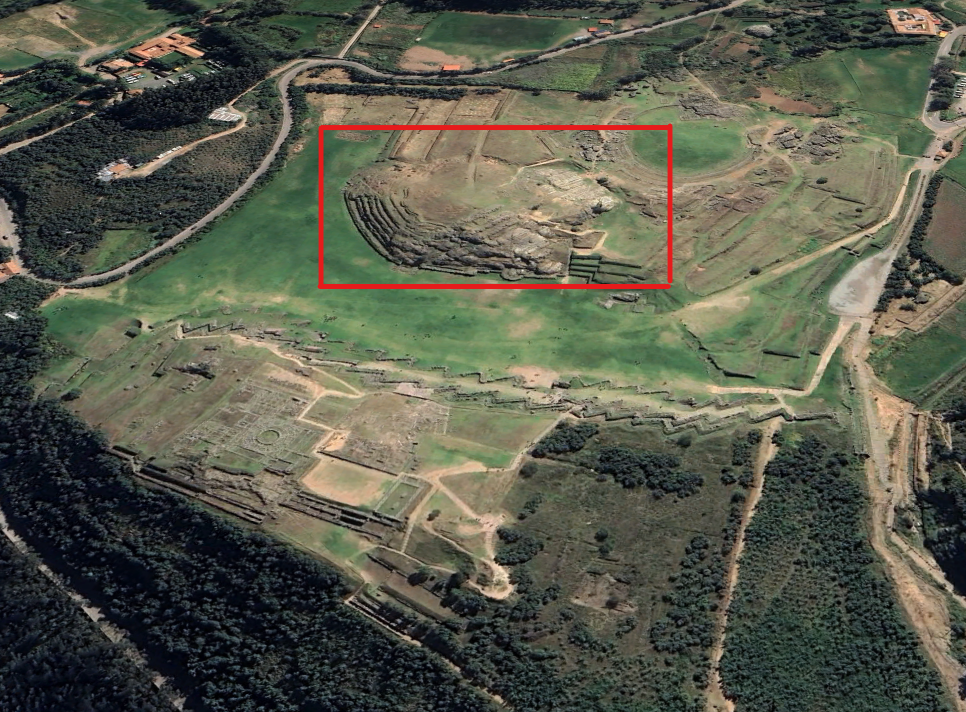
When we look at the Sacsayhuamán site, you can divide it into several parts, each of which is fascinating and misunderstood in its own right. You have in the southern part a ground plan of what once were several buildings around a circular structure. This is bordered on its norther side by the remnants of (aesthetically very well designed) parallel megalithic walls, having a sawtooth shape. They are made up of precisely fitting, mortarless polygonal masonry of large limestone blocks, the largest of which are estimated to weigh up to 200 tons and stand over 8 meters tall.

The northern part, depicted in the red frame in the uppermost photo, is in my opinion the most intriguing and therefore it will be the subject of this article. There is a hilly structure of diorite rock that looks like mechanically flattened and processed. On top of this hill you find, carved in this extremely hard stone, the ‘Trono del Inca’. It consists of a series of exceptionally precisely carved smooth ‘steps’ that are orientated parallel to the layers in the stone. The hilly formation is surrounded by what is left of a wall built up of megalithic very well fitting building blocks. It doesn’t seem to make any sense in our modern world view, but apparently these rocks were precious enough to be protected with a wall. Ask yourself, why would somebody build a wall around a rock formation?

On the northern side of the hill, you find that the rocks follow a strongly flattened slope. As a geologist, you would assume that this is the work of the glaciers that were present in the area. However, this flattening and smoothing has been done parallel to the light and dark mineral bands in the rock. It is important to notice that through this smoothing process, the entire hill has been redesigned into a ‘bumpy’ structure. What is the chance that a glacier would exactly follow the direction of the mineral bands and thereby create these bumps? There are also certain layers that protrude, creating the impression of a slide. It is very unlikely that they are caused by atmospheric weathering on these extremely hard layers. I consider it more likely that this whole morphology was engineered on purpose.
Geology and physics of the area
The rock of the hill is a thin-layered diorite, an intrusive igneous rock, part of the massive Andahuaylas-Yauri batholith, which is linked to the subduction of the oceanic plate beneath South America and the build-up of the Andes. It consists of repeating centimeter-thick layers of different mineral proportions. The darker layers are rich in amphibole and the lighter are rich in plagioclase feldspar. In fact, this kind of diorite is quite rare. An example of the same type of thin-layered diorite you find in the Skaergaard intrusion on the south-eastern coast of Greenland. The dark-light layering was formed during fractional crystallization in the slowly cooling magma chamber. In our case, however, the layering is exceptionally fine, so maybe some degree of metamorphic recrystallization happened.

The thin layering is interesting from an electromagnetic point of view, primarily because it creates electrical anisotropy that can influence an (induced) electromagnetic field. Parallel to the layering, electric current can flow easily along the conductive layers enriched in iron-bearing minerals like amphibole, biotite, or magnetite. Perpendicular to the layering, the current flow is hindered by having to cross resistive layers enriched in feldspar, creating a higher resistivity in that direction. The result is that he rock becomes electrically anisotropic, and its bulk resistivity depends on the orientation of the electromagnetic field relative to the layering.
On the other hand, there are also magnetic implications. If the dark, mafic layers contain magnetic minerals like magnetite and pyrrhotite, the layering can create a magnetic anisotropy, called a magnetic fabric. A magnetic fabric is a powerful concept in geology and geophysics. It refers to the preferred orientation of magnetic minerals within a rock, which gives the rock a directional, or anisotropic, magnetic property. This magnetic anisotropy can be enhanced by a preferred orientation of the crystals, which can be originated during sedimentation in the magma chamber, where elongated or platy minerals align themselves parallel to the magma flow direction. Apart from that, a later metamorphic deformation can recrystallize or rotate the minerals to align themselves perpendicular to the main compressive stress.
In any case, it would be very useful to further investigate the electrical and magnetic properties of these specific rocks to find out why they might have been of interest to the ancient builders.
The Inca Throne

Now let’s look at the Inca Throne. According to our current worldview it doesn’t seem to make any sense. It is quite an effort to create such a structure with ultimate precision in one of the hardest types of stone. So there must be an urgent reason for carving it, and to position it parallel to the fine layering in the rock. Maybe one day we will know how it was utilized, now we only see its remains. These remains have been preserved for us by the durability of the stone, otherwise they would probably have disappeared over the centuries.
And could it be that the flattened and smoothed bumps of the hill were merely a preparation for each to be carved into the same stepped structure as the Inca throne? It looks like this whole hilly structure is left unfinished and that it was intended to consist entirely of these stairways. The Inca Throne itself also looks like being still in the process of creation, if you notice the lower degree of precision in its secondary stairway (as depicted in the image above). So why did the ancient builders stop their activities so suddenly? Were they disturbed by a natural event or by something that was human inflicted?
So we have this structure purposefully positioned in rocks that stand out because of their anisotropic physical properties. We’re here to brainstorm, so here we go: Could the processed, precious hill and its carved-out precision art work represent some kind of energy point? And could the location of this special diorite formation be the reason that the megalithic Cuzco was founded close to it, being its energy source? Then you ask: where did that energy come from? Maybe from another side of the world as free energy to tap off. This is not a new concept, as the Serbian-American engineer Nikola Tesla has experimented with it extensively at the beginning of the last century. In the following section we will dive into that.
Tesla’s World Wireless System
Tesla saw the Earth as an giant electrical conductor, wrapped in an insulating atmosphere, and topped by another conductor: the ionosphere. This circuit could potentially be applied to supply free energy anywhere on our planet. By applying a massive electrical pulse at exactly the right frequency, a terrestrial standing wave could be created passing entirely through the Earth, from one side to the other. Tesla had calculated the required frequency to be an Extremely Low Frequency (ELF) close to the well-known Schumann Resonance (7.83 Hz).
In 1901, Tesla built the Wardenclyffe Tower on Long Island, New York, that would be able to pump an enormous electrical discharge into the Earth to ‘shake’ it. In his earlier experiments, Tesla could indeed detect the stationary wave that had bounced back from the other side of the planet. When you create a stationary wave (like plucking a guitar string), certain points stay still (nodes) and others vibrate with maximum intensity (antinodes). To tap this energy off, you could stick a specialized rod into the ground anywhere an antinode appeared and pull out free, high-frequency electricity. To amplify the ELF signal by the principle of Resonant Inductive Coupling, a pipe was stuck in the earth and connected to a so-called Tesla Coil.
Unfortunately, this power circuit was never put into practice because of dangerously high electrical potentials in the environment for human and animal health, but mainly because J.P. Morgan, the project’s financier, ended this free-for-all energy project in 1906.
Remarkably, Tesla considered the Egyptian pyramids of the Giza Plateau as an ancient version of his Wardenclyffe Tower, based on the architecture and building materials of the Great Pyramid. I will go into this in more detail in a future post, but indeed some similarities are there, especially since deep-going pipe-like structures seem to be present beneath the pyramids (Filippo Biondi et al).
Possible ancient engineering
I’ve speculated before that the Inca Throne, with its anisotropic electromagnetic properties, could have been an ancient energy point. This receiver would then have been tuned to the resonance of the Earth’s ELF standing wave. What’s to stop us from just speculating further? Could this ‘stairway’ have served to convert the ELF wave into an electric current and amplify it? Another point to consider in this context is the following: If we are to believe the looting Spanish invaders, the Incas in the Peruvian Andes had an almost inexhaustible supply of gold and silver. If gold and silver were mainly of religious and symbolic value to them, one might wonder where the excessive amount came from. Could it be that the Incas inherited these quantities from a previous civilization? And that this earlier civilization needed these metals for their advanced technologies?
Let’s first consider what an ELF wave exactly is. It is an electromagnetic wave with incredibly long wavelengths (thousands of kilometers), that can penetrate deep into the Earth’s crust where other signals would be absorbed. Due to its extremely low frequency, the electric and magnetic fields act independent of one another. When the ELF acts on a layered electrically or magnetically anisotropic material, the anisotropy induces electrical currents by inductive coupling. These induced eddy currents will preferentially flow along the more conductive layers.
Still, these currents would be very weak, and like with the Wardenclyffe tower, the received current would have to be amplified. Now the gold and silver can become significant. The steps show a preferred direction of magnetic flux, imagine now that they would have been covered by a layer of gold or silver. Resulting eddy currents in the highly conductive metal become localized and much stronger in the areas directly behind the rock’s preferred magnetic axis. You can further tune this to reach electromagnetic resonance, where the electrical current in the silver can oscillate at much higher amplitudes than the standard ELF wave could produce on its own. This may also explain the extremely precise flatness of the steps. It should as much as possible prevent scattering of the electrons at the rock-metal surface, which would convert the energy into wasted heat rather than a directed current.
Up to now, we can only speculate about the technologies used, if any, which is what I like to do in this blog. Just use your imagination, and with that, realize that the basic laws of physics have not changed between then and now.
Contemplating it all
Of course the idea of the Sacsayhuamán hill being an energy point connected to an ‘electrical pump’ located on the Giza Plateau seems far-fetched. But the structures we see are as incomprehensible as a modern iPhone would be to an Inca twelve hundred years ago. Clearly, there is some kind of advanced technology involved, probably of a non-destructive and non-polluting nature and free for everyone to use. This technology pre-dates the Inca culture by far and may go back tens of thousands of years, or more. I think we should try to understand these long-gone achievements, considering our current challenges of coping with all the energy-consuming industries. We need this badly!
Leave a Reply